Aaron Sorkin never troubles himself with the final product. It’s always the process that makes his shows special, and for the most part he explores it wonderfully. The long shots are glossy, and the dialogue--though sometimes admittedly a bit of a caricature of itself--remains some of the smartest on TV. Mix in a cast of smart, good-looking people working hard at what they love, and for the most part, you’re all but guaranteed success.
But, and maybe this is a cherry of Sorkin’s past shows, the end-product always winds up being really good, always winds up becoming the actual product of those smart, good-looking people whom you’ve been watching working hard at what they love. Sure you only see clips of Sportsnight, Sorkin’s first and very underrated show, but when you do it feels real, feels like you’re watching any two anchors chatting sports on ESPN. And when Martin Sheen delivers a speech it sounds—hell it even feels—like how a President should sound.
And I guess that’s why I’ve been grappling with Sorkin’s latest, “Studio 60 on the Sunset Strip.” It has big, beautiful, Goodfellas-esque long shots. It has snappy dialogue. It has an emphasis on writing (a TV show with a self-conscious emphasis on writing, let’s all marvel at that for a second or two) and, while I miss Toby and Leo, it does have smart, attractive people working hard at what they love.
But now, and for the first time, it’s what they make (and not how they make it) that has unfortunately eclipsed the Sorkin magic. The skits, or at least what we see of them, never seem to click with what everyone is working on. Unfortunately, this new show feels like a clearing-house of all the lefty topics he wanted to address during his time on ‘The West Wing’ but never got around to; ‘The West Wing’ was a perfect launching pad for all of Sorkin’s gripes with the right and the left. It was even great at suggesting policy based around those gripes, policy that remained congruent with the drama’s setting. But it can’t work like that in a show about a comedy show. Studio 60 has become a sketch show, but its Sorkin’s sketches that we see aired, and never the characters’.
Why? Because the skits simply aren’t funny. Sorkin has pulled a Dennis Miller like mistake it seems, trying to prove how smart he is while ignoring the only—I repeat: the only—rule that everyone has to abide by while writing comedy: Be Funny.
In comedy, you can be political, you can attack pop culture. You can air out social, economic and national tensions in a healthy and safe way. But before you do you have to earn it, and you earn it by making us laugh. Remember that while those great and original SNL episodes? Yes, they had Pryor and Chase screaming racial obscenities at one another. But they also had Ackroyd and Curtain donning cone heads and chugging six packs. They had landsharks. They had Belushi slicing through hoagie with a samurai sword. And eventually they even had Gumby, damnit.
But Sorkin gives us ‘Science Schmiance’, a watered-down game-show intent on attacking the religious right’s oftentimes tenuous relationship with the physical universe. He goes after CNN talking heads, easy targets sure, but Jon Stewart can do more with just one mug to the camera in response to the discussion of Sadaam’s “hidey-hole” than Sorkin can with five hundred words of scripted dialogue going after Nancy Grace. They even have another cast member appearing in a nearly suicidal role as a medieval warrior-Queen alluding to ancient battles while dealing with modern life. Yikes.
It might have started with the very first bit, the first ‘revolutionary’ skit that Matthew Perry’s character was going to use to revitalize the fictional Studio 60. So he puts on a musical send-up of ‘Modern Major General’. Cute. Clever. Predictably Sorkin. But not funny.
(I said ‘predictably Sorkin’ and I meant it: I really wonder if Aaron is trying to write himself in to what used to be the duo of Gilbert and Sullivan. Sorkin displayed his infatuation with G&S already in The West Wing with Ainsley Hayes’ character. Enough, Aaron. We get it. You like musical theater. Maybe you should put on a show about the backstage goings-on of a musical theater troupe and get it over with. Enough already. Just stop it.)
Perhaps what’s most disappointing about it all is that Studio 60 is funny: Nathan Corddry’s character walking around in a lobster suit, Matthew Perry reacting to the ‘cocktail napkin’ of a bat that Sarah Paulson hands him, and Matthew Perry and Bradley Whitford squabbling are all funny. But the show-within-the-show never clicks the same way that Jed Bartlett’s speeches would click with Jed Bartlett.
Maybe Sorkin is trying to write Studio 60’s skits poorly to more accurately mirror SNL. But I doubt it: Sorkin gives us bad comedy when he means to (the most recent episode showcased two terrible Black comics) and Perry’s and Whitford’s characters are meant to resurrect the show, not dig it into a deeper hole.
Sorkin and SNL should both follow this advice: just turn down the politics. Our elected officials will always be ridiculous. That staple of American comedy isn’t going anywhere, so be patient. Come back to ridiculous caricatures, awkward situations, or just plain goofy for a little while and make Studio 60 the example for sketch comedy in the same way that President Bartlett was for American politics.
Thursday, October 26, 2006


Wednesday, October 25, 2006
Mis-enfranchisement: a dialogical poem by a native son of New Hampshire
 (Settler's Green shopping plaza, North Conway, NH, at the base of the White Mountain National Forest)
My state has grown so quickly in the last few decades. We went from the richness of the lumber barons to the poverty of those who really were the state’s population in those preceding rapine years, and from there, well, to farming and then tourism and IT in the southern part of the state. The tourism is new enough, but the IT is very recent indeed, and however long the IT industry lasts, the tourism can last longer if we’re intelligent about it.
But now we’ve got all this money from the tourism in my generation and the next generation, wow, the amount of wealth they have comparatively, they’re really out there. And with all this money, we’ve got always in the top five of public school systems in the country.
It’s not that high.
It is. And these schools are so good that they train the kids for the world at large exceptionally well. If you’re smart, you can get a top-notch education in one of New Hampshire’s public schools and if not good enough than certainly enough in one of its excessively numerous private schools.
It’s always difficult to go home, you know when I visit the town where I grew up, I realize that I’ve got noone there who I know, they’re all graduated from out-of-state colleges. And your friends who are there aren’t your friends anymore. I guess it’s all out of the possession of power.
And when you’re raised and educated so well in a state whose main source of money has been applied so responsibly and charitably to the betterment of the society in the development of the institution of public schooling, that its industry has not been developed proportionally to accept the influx of talented young people into its work force, and so we have to leave. What are you going to do, if you graduate from an NH public school? Go to UNH? Which is really an amazing school, but that question seems like a legitimate one to all the people who state it—staying around at UNH appears as a failure to many.
It’s got a great honors program.
One of my friends is in the civil engineering program, and it’s a really amazing set she’s taking. [pause]
And we’ve really got nothing else to do, except work in IT. Only that there can only be so many people predisposed to being IT professionals.
So they could maybe be ski-lift operators or instructors?
Right, exactly. So what I’m saying is that we’ve got a perpetual diaspora of talent in our society. Picture like our ancestors in the beginning stages of capitalism, with free cities run by associations of leagues, generally. And from there to stronger mercantilisms and the formation of wealth centers, cities. Now the heirarchical structure would make it presupposable that the strongest members of a society, of a family, would go to where the opportunities were best. So the eldest or smartest son would go to the town to make his fortune. And the smartest would always be lured away to the cities by its promise, just power naturally wanting to consolidate itself and this facilitation of it in the free(er) transportation of goods and wealth generally.
You know, my house up in the country it’s some neighbors I see who are you think the talented are always lured away from the country to the profit of the city. [double entendre, unrecognized] It shows after five, ten generations of this.
Yeah.
Yeah.
[pause]
So basically what you’re describing is a darwinian skimming off of the gene pool.
Yeah.
But what I – But what if it’s this, that [pause] it’s a defense mechanism, that since the ‘smartest’ are lured away to the cities from the countryside, then the actual ‘smartest’ one would be the one who, if we’re okay that humans evolutionarily require contact with other humans, like Marx’s species beings, then the smartest one is the one who finds a way to remain in the community, which is the one who appears to the powerful one who steals the poor community’s children, who is apparently stupid to the hegemonic in order that he might avoid them taking him from his community.
You’re promoting the slave mentality.
I think it’s just the opposite, beause I’ll allow that the slave mentality is an entirely real phenomenon, this is more counterposed against the hegemonic. I’m saying that the dominant has no conception at all of its subaltern. That the dominant did not ever completely form the subaltern because it is a history that insists on the pre-heirarchy stage, and the dominant have no access to this history because they are always themselves-plus-history, so while I do not defend any transcendental historical element, I say that the dominant’s attempts to understand what it controls and creates are always one step behind the subordinate’s. That even if one group ‘creates’ the history of another, it cannot decode the present.
Case Study
The other day as I was reading about the explosion of print culture in the mid-seventeenth century, I came across the origin of the terms 'upper case' and 'lower case'. In a seventeenth century printer's shop, the arrangement of letters was organized so that the compositor could locate all the letters necessary by reflex - and invariably the capital letters were in a tray higher on his desk than the uncapitalized ones.
Tuesday, September 19, 2006
A Temporary Introduction
The Magistrates Should Be Elected by the People, a 1798 essay by Hegel in which he writes:
Peaceful satisfaction with the present, hopelessness, and patient acceptance of an all-too-vast and omnipotent fate have given way to hope, expectation, and courage to face the new. A vision of better, juster times has come to life in the souls of men, and a longing and yearning for a purer and freer destiny has moved all hearts and alienated them from the present reality."

And yet he delineates between "everyone who, in the midst of change or in preserving the old, seeks only his own limited advantage or the advantage of his class" and "men of nobler aspirations and purer zeal", recognizing the inextricable implication of the former in the political order of the present and locating the possibility for change within the disaffection of the latter, those already ideologically dislocated from the present.
The importance of this distinction becomes evident in Hegel's existential diagnosis of conservativism: "If a change has to happen, then something has to be changed. So banal a truth needs to be stated, given the difference between fear which must and courage which will; for whereas those who are driven by fear may well feel and admit that change is necessary, they nevertheless display the weakness, as soon as a start has to be made, of trying to hold on to everything they possess."
Conservativism then as a tension between public and private imaginations, a tension between a recognizance of what change society must undergo and a failure to reimagine the self within this new future. To extrapolate, liberalism becomes the locus of Hegelian courage, the point at which public and private imaginations become synchronized and coherent, perhaps even interchangeable.
It is this project of liberalism, more than two centuries later, that I hope this blog can address, with all the apocalyptic urgency of Hegel's own essay. ("The feeling that the political edifice as it still exists today cannot be sustained is universal and profound. The anxiety that it may collapse and injure everyone in its fall is also universal.")
This blog is, in some way, an effort in imagination itself, an attempt to invent the discursive practices, the languages and the ethical infrastructures that will allow liberalism to accumulate cultural significance. This includes philosophical discussions, musings on culture, analysis of the political melee, but especially conversations that attempt to synthesize these diverse elements of our community's collective imagination into something of a coherent, though constantly and necessarily shifting, nexus of thought.
In particular, I hope we can begin to bridge the gap between private and public belief, between theory and praxis, and move beyond the various aporias and sites of apathy that have plagued young academics since that imaginary moment in which meaning dissolved and we were forcibly entered into the post-industrial, post-modern, apathetic world.
More to come later, but hopefully this offers a meaningful introduction to the project at hand.
Peaceful satisfaction with the present, hopelessness, and patient acceptance of an all-too-vast and omnipotent fate have given way to hope, expectation, and courage to face the new. A vision of better, juster times has come to life in the souls of men, and a longing and yearning for a purer and freer destiny has moved all hearts and alienated them from the present reality."
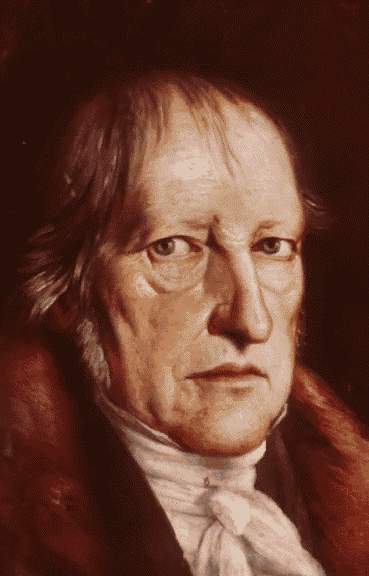
And yet he delineates between "everyone who, in the midst of change or in preserving the old, seeks only his own limited advantage or the advantage of his class" and "men of nobler aspirations and purer zeal", recognizing the inextricable implication of the former in the political order of the present and locating the possibility for change within the disaffection of the latter, those already ideologically dislocated from the present.
The importance of this distinction becomes evident in Hegel's existential diagnosis of conservativism: "If a change has to happen, then something has to be changed. So banal a truth needs to be stated, given the difference between fear which must and courage which will; for whereas those who are driven by fear may well feel and admit that change is necessary, they nevertheless display the weakness, as soon as a start has to be made, of trying to hold on to everything they possess."
Conservativism then as a tension between public and private imaginations, a tension between a recognizance of what change society must undergo and a failure to reimagine the self within this new future. To extrapolate, liberalism becomes the locus of Hegelian courage, the point at which public and private imaginations become synchronized and coherent, perhaps even interchangeable.
It is this project of liberalism, more than two centuries later, that I hope this blog can address, with all the apocalyptic urgency of Hegel's own essay. ("The feeling that the political edifice as it still exists today cannot be sustained is universal and profound. The anxiety that it may collapse and injure everyone in its fall is also universal.")
This blog is, in some way, an effort in imagination itself, an attempt to invent the discursive practices, the languages and the ethical infrastructures that will allow liberalism to accumulate cultural significance. This includes philosophical discussions, musings on culture, analysis of the political melee, but especially conversations that attempt to synthesize these diverse elements of our community's collective imagination into something of a coherent, though constantly and necessarily shifting, nexus of thought.
In particular, I hope we can begin to bridge the gap between private and public belief, between theory and praxis, and move beyond the various aporias and sites of apathy that have plagued young academics since that imaginary moment in which meaning dissolved and we were forcibly entered into the post-industrial, post-modern, apathetic world.
More to come later, but hopefully this offers a meaningful introduction to the project at hand.
Subscribe to:
Posts (Atom)